
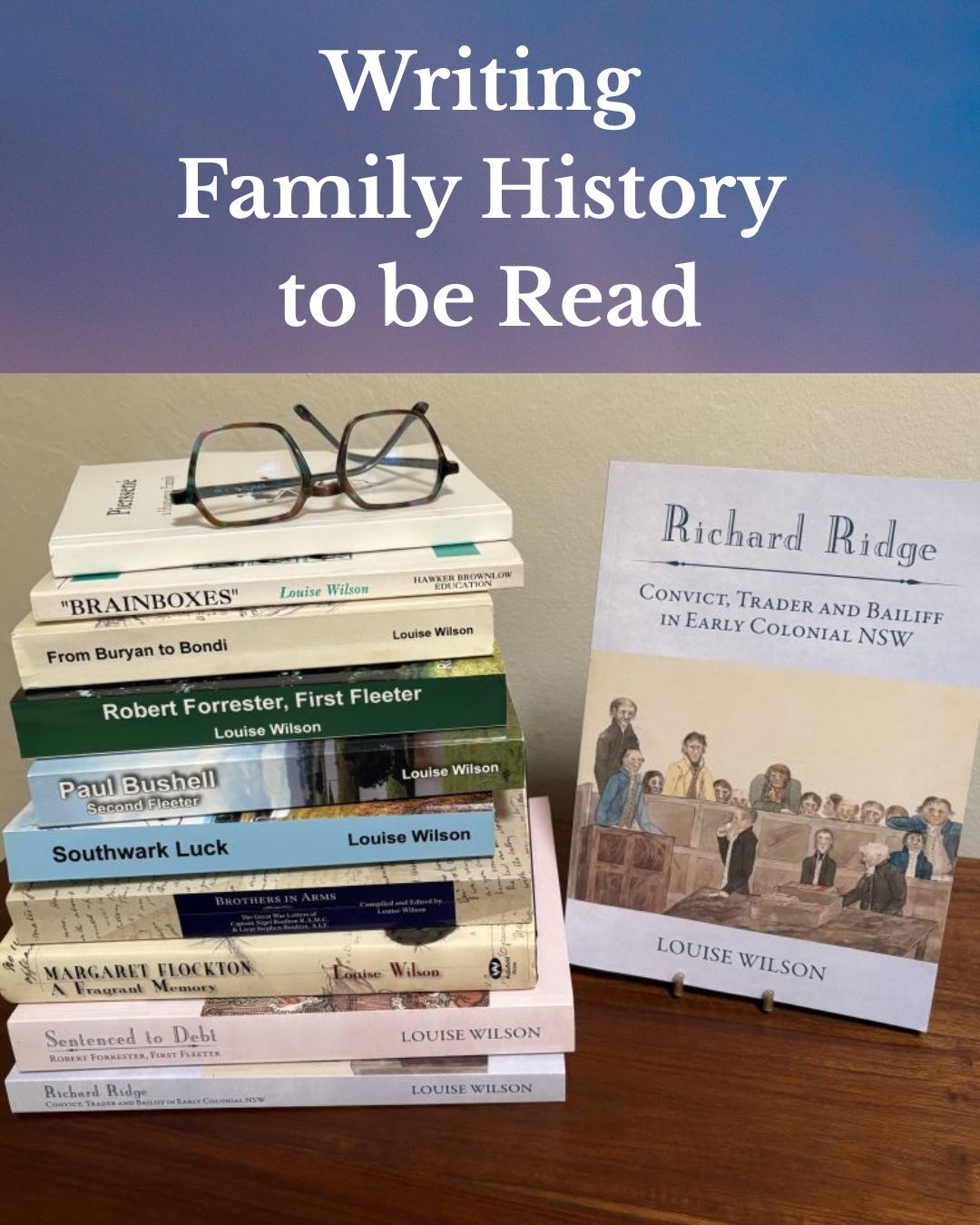
August is National Family History month, a reminder to me of a career I never expected: the devotion of nearly two decades to writing about family members who, with one exception, died long before I was born. And that doesn’t count the preceding years allocated to researching these people, before I started writing. Why have I spent my time this way?
Long ago I worked in the finance sector and realised, then, that I quite enjoyed explaining complicated topics in international finance to the general public. Some of my colleagues sneered when several articles were picked up by what they called 'the gutter press' but it pleased me to reach 'the man in the street'. What’s the point of words on a page if no-one reads them?
The years passed, and my personal writing quest shifted. I’d collected a great deal of family history information and I needed to learn the craft of telling a good non-fiction family story about these hitherto unknown family members.
I wanted my family history books to be read, hoping to engage my readers in a compelling story, a difficult task in this specialised writing genre. The storyline is dictated by the facts you’ve collected during a prolonged and often boring period of research. These facts, frequently snippets of random information and with many gaps in chronology, need to be explained and set into meaningful order. The writing task is to create a compelling narrative, able to be substantiated by your facts. Unlike the authors of fictional stories, you cannot ‘make stuff up’ —but you can use historical context to help readers understand the world in which your forebears lived.
Joining various writing groups I learned much, including the need for good openings and conclusions. Experimenting with this idea, my self-published book 'Sentenced to Debt: Robert Forrester, First Fleeter' opens with:
'When Robert Forrester moved to London in the early 1780s, he was a ‘nobody’ in terms of documented history. The events of one night in April 1783 turned him into a ‘somebody’.
It could never be proven exactly where Robert originated, although careful DNA sleuthing pointed in the right direction, but I was able to uncover a great deal about his life as an adult. Several hundred pages and forty-odd years later, his story concludes with:
'Robert Forrester struggled to make much impact in his world during his own lifetime. He would have been startled to think that a book would ever be written about him. He would have been a ‘nobody’ had he remained among the masses at home, but he ended his life as a ‘somebody’, one of the resilient if inadvertent European founders of modern Australia.'
These opening and closing lines clearly defined the book’s historical context and engaged the interest of readers, from the start to the finish of this particular book. A judging panel agreed and it won the Don Grant Award, 2020, presented by the Family History Connections group (formerly the Australian Institute of Genealogical Studies) in Melbourne.
I faced a different dilemma in my latest book ‘Richard Ridge: Convict, Trader and Bailiff in Early Colonial NSW’. At first his story seemed like just another ho-hum tale about a Third Fleet convict, except that the role of a bailiff at this time in Australian history had never been closely examined. After spending years bogged down in the research process, I realised I could contradict all the existing family trees on Ancestry, having tracked down his actual year and place of birth to Oxfordshire, not Sussex as claimed. This discovery also provided a startling new angle on his family of origin, which I used in my opening short paragraph:
Richard Ridge entered the world in Oxfordshire in 1766, the year his first cousin Betty Rudge became a Viscountess, and he closed his eyes for the last time in the penal colony of New South Wales in January 1842, ‘in the 76th year of his age’.
This Ridge book, also self-published, won the Don Grant Award, 2025. It was described by the three judges as ‘the model of how a biography of an ancestor should be written’.
Another of my books, published by Wakefield Press in Adelaide, presented a different challenge. ‘Margaret Flockton: a Fragrant Memory’ was the story of a scientific botanical artist, the only one of my various biographical subjects known to me personally (as Aunt Mog, my grandmother’s aunt, a fact not made known to the reader until the Acknowledgments section at the end). Should I have started this book when Margaret, then a spinster in her early thirties, was singled out by a very chauvinistic art critic for the same ‘works of genius’ praise he bestowed on her fellow exhibitors at Sydney’s Art Society Exhibition in 1894, luminaries such as Tom Roberts , Arthur Streeton and Sid Long? I decided I wasn’t writing a book to appeal to art snobs, so readers began with a short Introduction, outlining the themes of the book, followed by Chapter 1 which started with:
Every story has to start somewhere. Its cast of characters has to be assembled and introduced, one by one. For Margaret, the main players during her life in England were her immediate family but her story does not begin with her at centre stage, at the time of her birth. Nor does it follow the current fashion of opening with an exciting event later in her life before back-tracking.
In Margaret’s case, the best place to begin her story is with her young father, Francis Stephen Flockton , known as Frank . His early life, his attitudes and his behaviours had a more fundamental impact on her life than on the lives of her two sisters. To understand Margaret, Frank’s favourite child, first one must know something of Frank.
Margaret doesn’t enter the story until her birth, in Chapter 2. At the launch of my book, Professor Dame Marie Bashir said ‘This beautiful book is a gift to Australia’, and it went on to win the Don Grant Award, 2016.
It’s clear that my efforts as a family historian, delving into past lives, have been personally rewarding. Recognition as the writer of various life stories is gratifying. Even better, I’ve felt useful for my role in helping many Australians learn about a forebear and gain a better understanding of our country’s early colonial history after reading my books, some of which are available in libraries. I’d love to see more family historians commit to the task of writing about someone they care about. It’s definitely time well spent on the worthwhile goal of writing to be read.