

Robert Forrester, First Fleeter
| Description Readers' Comments News and Updates Publication Details To Purchase |
A Founder of Modern AustraliaHighly Commended in Alexander Henderson Award, 2009. Sydney's early history abounds with tales of men and women behaving badly. Robert Forrester, who arrived in Sydney Harbour aboard the First Fleet vessel ' Scarborough' on 26 January 1788, at first glance was just another ne'er-do-well. He was caught up in a 'scam' in London. He was charged with drunkenness and insolence in Sydney. He was the first man in Australia who appeared before a court enquiry into the murder of an Aborigine. His legal wife, and then his second 'common law' wife, disappeared from the records. Yet determined detective work, recreating his adult life, has shone a new light on these aspects of Robert Forrester. His is the story of a life fully-lived, struggling on the frontier of European settlement beside the Hawkesbury River. His life demonstrates the economic impact on an individual of floods, fire, famine and the NSW Corps, creating one of the first 'Aussie battlers'. Robert Forrester was one of the first convicts who chose to become an Australian. He did not give up his supreme effort at the Hawkesbury, when others did. He raised his family 'to habits of industry'. He was able to attract three women as partners, at a time when men vastly outnumbered women in the fledgling colony of New South Wales. The message on his headstone at St Matthew's Windsor indicates that his family loved him. A tightly-focused, very readable and engrossing biography of Robert Forrester, this book illuminates the life events and character of an individual convict who helped to found the modern nation of Australia. SOLD OUT - but the UPDATED and REWRITTEN version, 'Sentenced to Debt: Robert Forrester, First Fleeter', is available online at BookPOD. | 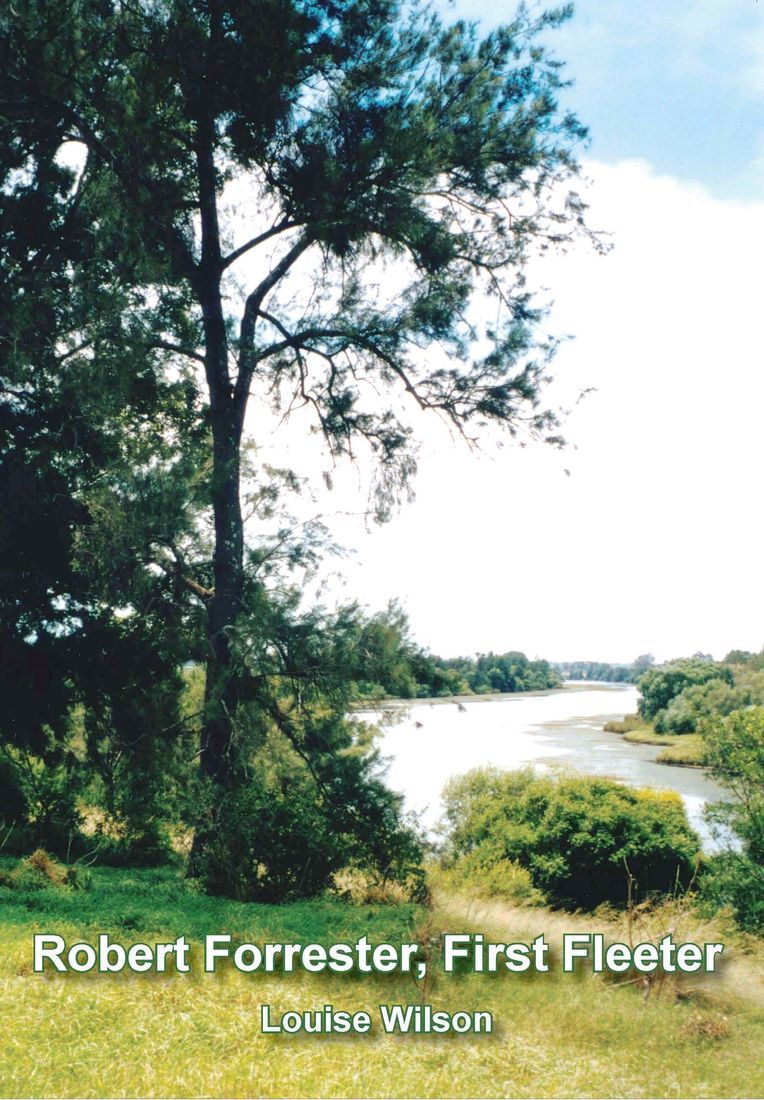 |
Readers' Comments
| The book is very interesting and extremely readable - you have made the character into a real person and the book into a story, not just a text book. Eric Wormald, Mar 2007 (re Second Draft) You have done a marvellous thing. No-one has written about Robert Forrester before this. The stand-out features of the book are its extraordinary detail, excellent use of source material and good focus. You did not stray into generalities about the times, but kept to your topic. I was not so interested in Robert's journey to Australia, as the First Fleet story is well-known, but once he arrived I became very engaged and my interest did not flag throughout the book. The way you wove the Hawkesbury floods into the story and explored their economic impact on an individual was really interesting. You certainly had a good story to tell, and I enjoyed it. Reading Panel Member, Sep 2008
The book is very interesting and readable. Thorough research is evident, and the story contains great detail. The documents and references used provide strong support for the author's hypotheses. The book gave me some new ideas about how to research individuals in history. John Jennings, Seymour & District Historical Society, Dec 2008 I knew the general history of Sydney, but nothing specific about the life of anyone who came with the First Fleet. It was very surprising that so much could be found about someone who left no personal records. The use of many quotes, with the old vocabulary, grammar and spelling of the time, added a great deal of interest to the book. I kept on reading, because I wanted to find out what happened to Robert. Julia Woodhouse, Dec 2008 It is a pleasure to read something that has such meticulously detailed research combined with an easily readable storyline.Bev Parker, Jan 2009 I am enjoying the Forrester book immensely. I should have ordered 2 copies as I seem to spend a lot of time reading to Glenda as she wants to know what is making me laugh etc when I am engrossed with the book. The way you have woven the historical records / quotations into the story is very well done and makes for fabulous reading. Stephen Bushell, Jan 2009 My heartiest congratulations. I can't believe it. I thought it would be good, but it's bloody good. It's even got decent English. Well done. Alison Davis, Jan 2009 I truly enjoyed your book and I think it puts Robert in a true perspective for the first time. We do have a lot to be proud of.Ian Nicholls, Jan 2009 As a post-war immigrant to Australia I had no idea, until I read this great book, about how much the first settlers of this country suffered. Constance Bruce, Jan 2009 Louise Wilson's history, Robert Forrester, First Fleeter is a remarkable feat of research. We have such a clear picture of Robert Forrester and his milieu through this book that it is hard to believe that he was illiterate and left no written trace except for his mark, a shaky cross, on some legal documents. Louise has assiduously tracked documents and history across continents. She has often had to rely on exclusion - when she would be presented with a series of possibilities she would carefully research all options until she could safely exclude impossibilities. So behind the book is a mass of research of blind alleys and dead ends that took her nowhere but enabled her to say with some degree of certainty, this couldn't be the woman who later became Robert's wife, or this couldn't be Robert's family. Louise gained her analytical approach to history through her economic training. But it is not just her analytical skills that are impressive. She has written an immensely readable personal history which illuminates much of Australia's early days. You don't have to be a Forrester to enjoy and to gain much from this book.Rosemary Cameron, Director, Melbourne Writers' Festival, Excerpt from Speech, 18 Feb 2009 I have been very impressed with what you have written and the way you have described the life 'around' Robert and Isabella by talking about neighbours that they would have known and the hardships that they all faced in those times. Of course I knew they had problems with the aborigines but didn't really give them that much thought until you raised it. You took my imagination back to those times and made me glad I didn't live in those days. Rod McDonald, Feb 2009 I just wanted to thank you for the wonderful book about Robert Forrester. I almost feel as though I know him, and I certainly appreciate you taking the time to put all your wonderful research into such a fabulous book. Ros Taylor, Feb 2009 It is a great story. The best thing about your book, for me, is that it made me think - how did the colony survive the difficulties and setbacks? Like you, I think the portrayal of the convicts as no-hopers shows how poorly understood our history is. They must have done something right. OK, no doubt there were strange characters in the first fleet but there must have been a lot of competent and industrious people - otherwise the settlement would have collapsed. Your book has the right focus - on the lives of people like Robert Forrester who helped the settlement keep going in the early precarious years. You are right in admiring Phillip as governor - how he managed to hold things together for the first four years is amazing. Your book gives a deeper understanding of the relations with aborigines. It is clear that gratuitous killing of aborigines was not sanctioned. Anyone involved in injuring or killing aborigines would face consequences. There were many tragic incidents, but by 18th century standards, there was a recognition by Phillip and others of aborigines as people, unlike many new world colonies. While we need to recognise the wrongs done to aborigines, we need to acknowledge that there were people trying, often unsuccessfully, to limit the damage. I don't know of any case where people from an advanced culture have come into contact with a stone-age, non-agricultural people without tragic consequences. Congratulations on a fine book.Nigel Stokes, Feb 2009 I am in awe of the detail and the research you have done. Great story.Frank Dennis, Feb 2009 Through your book I have grown quite fond of Robert and his family, probably because having lived in the Hawkesbury region since we married, I always hoped to find one of our early ancestors had farmed in the area, but no success. I have kind of 'adopted ' him. Kay White, Mar 2009 I found your book very interesting - all the more so because I am a direct descendant. I feel I know Robert personally and admire his efforts under such appalling conditions. Paula Bosman, Mar 2009 | By sheer good fortune, I came across your book on Robert Forrester at the Victorian State Library last Monday, a week ago today. On Friday, I purchased four copies from the Athenaeum Library and I have done little but read it since. Congratulations. It is a wonderful effort. I thank you for saving me years of hard work researching Robert Forrester and Isabella Ramsay. However, I envy you the joy of discovery and the satisfaction your obviously derived from weaving the threads of the story together to develop such a compelling narrative. Graham Cocks, Mar 2009 Just a quick note to let you know how much I enjoyed reading Robert Forrester, First Fleeter. The night after the Sydney launch I went to bed quite early and started to read your book, expecting to nod off after a few chapters. I ended up reading the whole book. Being raised in the country I particularly enjoyed the chapters describing Robert's efforts at farming in the Hawkesbury River valley and his regular disappointments at losing his entire crop to flood or drought. It all seemed very familiar and quite contemporary. Rollo Crawford, Apr 2009 We attended the launch of Louise's book, and have read it, enjoying it thoroughly, especially her rethinking of some of the traditional assumptions. She has convinced us that he was an innocent transportee! And we are pleased that Isabella's death has been identified. Ian & Margaret Stehbens, May 2009 Congratulations on a wonderful story of a man who showed great courage and commitment to forge out an existence in an unknown country. Your research and detail of his life is amazing. Sandra Forrest, August 2009 One thing I particularly liked about your book was the flavour it had of day-to-day life among the non-famous. Your research is remarkable. Julia Perry, August 2009 Thank you for your wonderful book. We feel so proud of our forebears now. I just wish my father was still alive to enjoy the story of Robert! Narelle Steer, August 2009 Thank you for your painstaking research and well-crafted book. Your reference to contemporary records are made with such skill that the reader is taken to the banks of the Hawkesbury at the turn of that other century.The appeal of the book, and its value as a history, extends to a far wider readership than that comprised of Robert's descendants. Phillip Perry, Sep 2009 I found your book to be the pinnacle of what every genealogist would like to achieve. A very good read based on excellent research. Greg Cummins, Sep 2009 I was interested in the book and read it in a couple of nights. I know that Hawkesbury country. It was part of the study area for a book I wrote more than thirty years ago called 'Colo Wilderness'. You unearthed some good material and filled out the picture I had of that district. Your book showed an awareness of the physical environment, which I always appreciate. That Hawkesbury country is quite special isn't it, a kind of crucible of the nation. Your detective work was admirable, as was your restraint in the use of the material. Peter Prineas, Sep 2009 I just finished Robert Forrester, First Fleeter. I really, really liked it. I read it in 'one sitting' - whenever I had to put it down, I couldn't wait to continue and discover what happened next. All the numerous footnotes didn't bother me at all and especially the Appendices were great. You have done so much work with it - checking and counterchecking every little bit of information. I was born in Finland and came to Australia and Melbourne in 1998. My adjustment to life in Australia was far easier than Robert Forrester's, however, I still could relate to what he must have felt, seeing a completely different world than he had been used to. I also feel indebted to all those men and women who built the great country where I now live. I can recommend Robert Forrester, First Fleeter to everyone who wants to know what really happened when modern Australia was born. Elina Rydman, Oct 2009 I have just finished your book and would like to congratulate you on a fine read. It was so interesting to follow someone's life through those harrowing times. Your research seems endless in producing a fine historical document from the limited and fragmented sources. I will be looking forward to the sequel. Kevin Best, Mar 2010 Mum, let's be honest, I've never been interested in your family history work. I'm not sure I would have ever made the time to read the Forrester book unless you 'forced me' to bring it away with me. Surprise of all surprises, I found it really interesting! I learned more about early Australia than I ever did at school. It made such a difference following an ordinary man's story, suddenly it felt real to me. I felt very sad, reading the book. I'd never actually contemplated how tough the colonists' lives were. The thing that really blew me away was not having any currency and the issues that raised. What can I say but I'm very, very glad I'm alive now rather than then. I'm super impressed with the research, I could never have so much patience. I also appreciated your thoughts on what life might have been like and what the real story of the people might have been, like why Robert didn't attend to his affairs as we might expect today. I could see your own experience of farming led to a real understanding of the back breaking work and time involved. Definitely no time for the higher pursuits of life. Once again I am hugely thankful to be around now, with modern conveniences like the supermarket and local doctor's surgery. I got a lot out of the book. I hate to admit it, but when I get the time I am looking forward to the Bushell book. Though I hope that's the last, because I want my mum back! PS Just because I got a lot out of reading it, don't expect me to stop rolling my eyes back into my head when you talk about all your tedious research. Thea Stanley, Hong Kong, Jan 2011 N.B. Thea is forgiven for taking so long to read the book- she's the mother of two sets of twins, aged 4 and 3 (in Jan 2011). Review by E.C. Best in 'Descent', The Journal of the Society of Australian Genealogists, March 2009, Vol 39, Part 1, p 34 Review in 'Founders', Magazine of Fellowship of First Fleeters Inc, Vol 40, Issue 2, March/April 2009, p 3 Mention in 'The Millstone', Kurrajong-Comleroy Historical Society Newsletter, May-June 2009 Review by Joan Buckley in 'History', Magazine of the Royal Australian Historical Society, June 2009, No 100, p 13 Review in 'Ancestor', Quarterly Journal of The Genealogical Society of Victoria, Inc, Vol 29, Issue 6, June 2009, p 38 |


News and Updates
The book was launched in Sydney by Christine Yeats, Manager Public Access, State Records Authority of NSW. The event was held at the State Records Reading Rooms, 2 Globe St, The Rocks on 27 January 2009.
The book was launched in Melbourne by Rosemary Cameron, Director of the Melbourne Writers' Festival. The event was held at The Melbourne Athenaeum Library, Level 1, 188 Collins St (adjacent to the Melbourne Town Hall) on 18 February 2009.
The book was reprinted in 2011 and again in 2014.
The book is recommended as a Reference and Resource on the University of Wollongong's First Fleet Online site.
Special week at Norfolk Island: Each year Norfolk Island celebrates its Foundation Day, 6 March, the day back in 1788 when a small group of First Fleeters arrived on Norfolk Island to claim it for the Crown. In 2010 there was a special focus on Robert Forrester, due to the publication of my book. At 'Forrester Court', the spectacular Norfolk Island home of Robert's descendant John Forrester, I gave a short talk to the gathering.
I travelled to England in November 2017 and there investigated the possibility that Robert Forrester came from the Carlisle area, near Gretna Green. This was the last avenue of enquiry left open when the Forrester book was published in 2009. DNA research throughout 2018 has thrown cold water on this idea, instead opening up a whole new area for investigation.
This work delayed the new version of the Forrester book, originally planned for 2018. By 2019 the original version of the Forrester book had completely sold out but the new version remained incomplete. Illness in the author's family caused further delays. The completely new version of the book, entitled 'Sentenced to Debt: Robert Forrester, First Fleeter', was published in May 2020.
Remember - keep up to date with Forrester family news via my Forrester BLOG, separate from this website.
AND, if you're a descendant, you may care to join the Facebook page for Robert Forrester and his descendants. It's a closed group and you'll need to know your family tree details at the time you apply to join.
Publication Details
| Published | Louise Wilson, South Melbourne, VIC, January 2009 |
| Format | Paperback, perfect bound, 442 A5 pages, black & white illustrations |
| ISBN | 9780980447828 |
| Available | - Sold out through all outlets, replaced by 'Sentenced to Debt: Robert Forrester, First Fleeter', see purchase details below. |
To Purchase
This book has been very popular and the latest reprint has sold out. A completely new version with the title 'Sentenced to Debt: Robert Forrester, First Fleeter' was published in May 2020 and can be purchased here.